79.8%Highest average outdoor relative humidity (Pensacola)
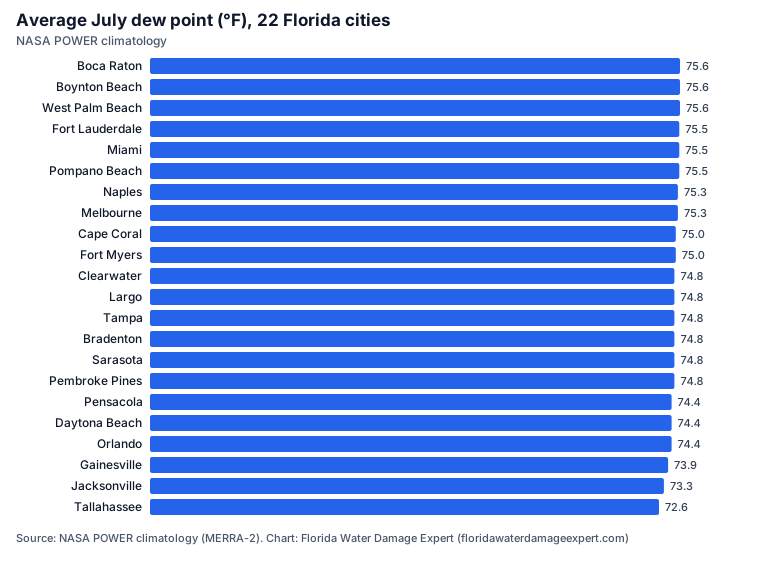
75.6 °FHighest average July dew point (Boca Raton, Boynton Beach and West Palm Beach)
60%Indoor relative humidity the EPA advises staying below
Outdoor humidity and dew point in 22 Florida cities
Long-term averages at each city's coordinates from NASA POWER.
| City | Average outdoor relative humidity | Most humid month | Humidity in that month | Average dew point | Average July dew point |
|---|---|---|---|---|---|
| Pensacola | 79.8% | Dec | 83.2% | 61.4 °F | 74.4 °F |
| Cape Coral | 78.7% | Sep | 82.9% | 66.7 °F | 75.0 °F |
| Fort Myers | 78.7% | Sep | 82.9% | 66.7 °F | 75.0 °F |
| Naples | 78.4% | Dec | 82.7% | 68.4 °F | 75.3 °F |
| Melbourne | 78.2% | Aug | 82.9% | 66.2 °F | 75.3 °F |
| Gainesville | 78.0% | Sep | 83.4% | 61.5 °F | 73.9 °F |
| Jacksonville | 77.8% | Dec | 81.6% | 60.5 °F | 73.3 °F |
| Clearwater | 77.6% | Sep | 83.2% | 64.4 °F | 74.8 °F |
| Largo | 77.6% | Sep | 83.2% | 64.4 °F | 74.8 °F |
| Tampa | 77.6% | Sep | 83.2% | 64.4 °F | 74.8 °F |
| Daytona Beach | 77.5% | Sep | 83.7% | 63.2 °F | 74.4 °F |
| Tallahassee | 77.4% | Dec | 81.9% | 59.0 °F | 72.6 °F |
| Bradenton | 77.3% | Sep | 82.3% | 65.2 °F | 74.8 °F |
| Sarasota | 77.3% | Sep | 82.3% | 65.2 °F | 74.8 °F |
| Boca Raton | 77.2% | Sep | 81.0% | 68.7 °F | 75.6 °F |
| Boynton Beach | 77.2% | Sep | 81.0% | 68.7 °F | 75.6 °F |
| West Palm Beach | 77.2% | Sep | 81.0% | 68.7 °F | 75.6 °F |
| Orlando | 76.7% | Sep | 83.8% | 63.5 °F | 74.4 °F |
| Fort Lauderdale | 75.7% | Sep | 78.2% | 69.4 °F | 75.5 °F |
| Miami | 75.7% | Sep | 78.2% | 69.4 °F | 75.5 °F |
| Pompano Beach | 75.7% | Sep | 78.2% | 69.4 °F | 75.5 °F |
| Pembroke Pines | 75.2% | Dec | 79.5% | 67.7 °F | 74.8 °F |
Sources: NASA POWER climatology (MERRA-2). Download the data (CSV).
Indoor humidity is what matters
Outdoor humidity in every Florida city on this page averages well above the indoor level the EPA recommends: indoor relative humidity should be kept below 60 percent. Air conditioning and dehumidifiers remove moisture indoors, so problems usually start where water gets in or air can't circulate.
After water gets in
- The EPA advises drying water-damaged areas and items within 24 to 48 hours to prevent mold growth.
- Fix the source of the water first: a leak, a roof opening or a clogged condensate line.
- Ask any restoration provider how they will measure moisture and confirm the area is dry.
Common questions
What humidity level prevents mold?
The EPA advises keeping indoor relative humidity below 60 percent. Outdoor humidity in Florida is higher than that year-round, so indoor air conditioning and ventilation matter.
How fast does mold grow after water damage?
The EPA advises drying water-damaged materials within 24 to 48 hours to prevent mold growth.
Sources and method
- NASA POWER — Daily temperature and climatology at each city's coordinates.
- US EPA: Mold course, chapter 2 — Indoor relative humidity below 60 percent.
- US EPA: A brief guide to mold, moisture and your home — Dry within 24-48 hours.